Bible Reading Challenge Blog
Day 22 – September 28, 2026 – Matthew 22
September 28, 2026There are quite a few seemingly unrelated teachings in this text. Jesus is being clearly tested and the testors are the religious leaders from all sides. He does give us the greatest commandment in this Scripture which is worth repeating. We are to love God with all of our heart, mind, soul, and strength, and our neighbor as ourselves. The law can be summarized by these commandments. In modern Christianity it is difficult to find a good balance. Often we can sense that we may think that salvation is all that is needed. Once I have a personal relationship with Jesus, that is all that is needed. It is a beginning, it is an important step. But Jesus says that we have to love our neighbor as ourselves and he puts that on par with loving God. We rarely do that. It is impossible hearing these words of Jesus to think that all we have to do is love God and everything else will follow. No, we have to love God and love neighbor and then, and only then, will everything else follow.
Day 21 – September 27, 2026 – Matthew 21
September 27, 2026Can you imagine someone telling the pastors of a church that the prostitutes and tax collectors will get to heaven before they do? That’s exactly what Jesus told the religious leaders after he rode into Jerusalem on Palm Sunday. That’s where we find ourselves in this Scripture, it is on Palm Sunday. Jesus rides in on a donkey as a sign of both humility and victory. He then cleans out the temple and then he starts healing in the temple. I had not noticed that before. It isn’t as if he goes and cleans out the temple and then goes home after a hard days work. No, he stays in the most holy of places, that isn’t his to claim in the eyes of the religious leaders, and does the work that he has been doing all alone, healing people. He is asked by what authority he did the healings, and he answers as he always does, with another question that the leaders are not able to answer, so he doesn’t answer. We are getting closer to the end of Matthew, you know that once you get to Palm Sunday, because we have less than a week left in Jesus’ life now.
Day 20 – September 26, 2026 – Matthew 20
September 27, 2026The parable of the laborers in the vineyard has always been one of my favorites because it reflects so accurately the current state of thought among believers. We complain that we only get what we don’t deserve. We don’t deserve to be freed from our sin while we were yet sinners, and yet Jesus showed his generosity toward us by dying for us on the cross. We often complain about the amount of money that professional athletes make, and here we are making that which we agreed to make and it just seems unjust. Our jealousy over God’s generosity is a pandemic that strikes so many and it throws our perspective out of joint. What we have received, the grace that we have through Jesus, is totally undeserved, and yet God showers it upon us. Spend the day today grateful for how God has blessed us, and don’t look to your neighbor, God can take care of them how He pleases.
Day 19 – September 25, 2026 – Matthew 19
September 25, 2026There are a number of teachings here that are difficult for us to hear in our 21st century ears. The teaching on divorce, that we should not divorce except in the case of infidelity, is very difficult when more than 50% of our marriages end up in divorce. This is true both in the church and in society in general. It should not be, but it is. Jesus gives us the template on how we ought to treat and understand children. We are called to see children as those to whom the kingdom of heaven belongs. What a different way than to think that they should be seen and not heard as some might way.
We then are given a lesson on what it means to be a disciple. It isn’t enough just to be good enough. We actually have to relinquish all that is more important to us than God to God so that we can have eternal life. Being a disciple is not about following rules or giving things up. It is about understanding what Jesus has done for us on the cross and how living our lives can now be so different than what society tells us it should be.
Day 18 – September 24, 2026 – Matthew 18
September 24, 2026I have to say that it doesn’t settle the heart to think at the end of this story that someone was tortured because of their cruelty, and that a metaphor is applied to us if we do not have mercy on others. I’m wondering what kind of motivation is it to have mercy if we know that if we do not have mercy then we will be tortured. That doesn’t sit great with me, but Jesus was telling parables in a way that people would be able to understand and that they would know how important it is for them to be righteous in their life.
We also have the parable of the lost sheep and the shepherd leaving the 99 and going on a hunt to find that one lost one. We also have Peter asking Jesus that we all want to ask Jesus, how many times do we actually have to forgive someone if they keep hurting us over and over again. And the answer is every single time. Now, her me well, that does not mean that we put ourselves in a position to be hurt again. If we are in a relationship that is harmful to us, we leave, this does not mean that we stay and submit to abuse. But it does mean that we forgive and allow God to heal our wounds as we have moved on closer to Jesus.
Day 17 – September 23, 2026 – Matthew 17
September 24, 2026We find a strange aggregation of stories, but the first of them, the transfiguration, probably the most impactful. Keep in mind that just about everything that Jesus does while on earth is reflected somewhere in the Old Testament as something that either a leader of the Israelites did, or a prophet, or something that someone of importance did before he did it. Going up a mountain and having yourself transformed and transfigured is very much something that Moses did. So much so, that the Hebrew word for his face shone and he had horns is pretty much the same. This is why we have this depiction by Michaelangelo of Moses.
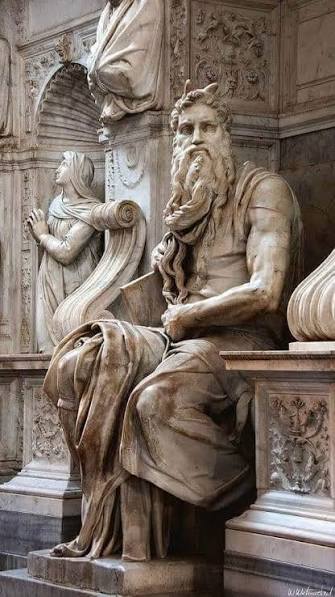
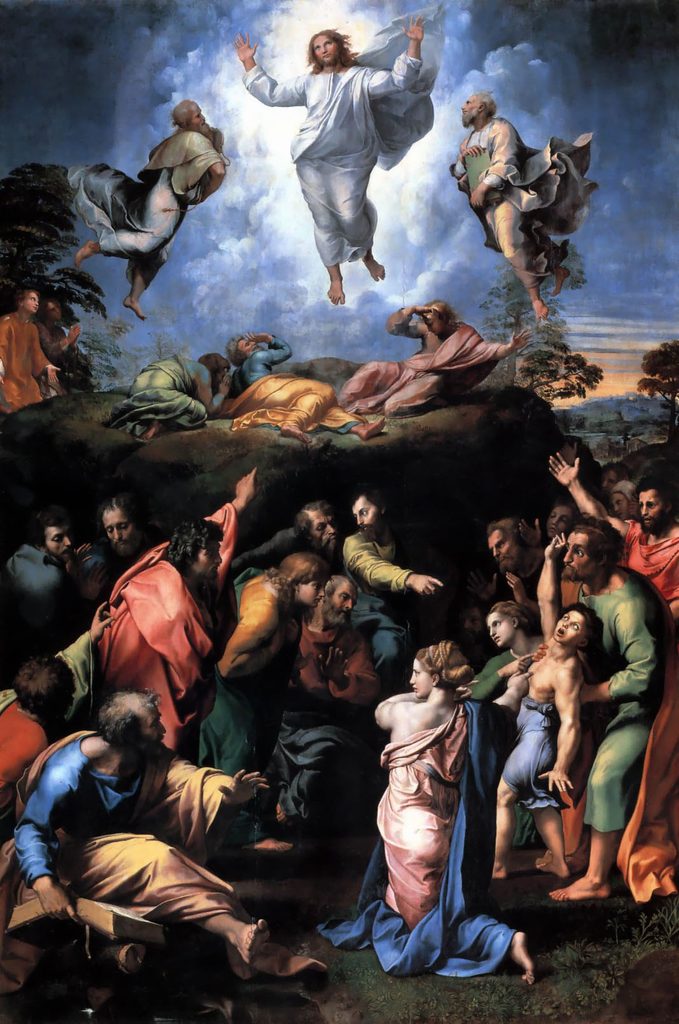
God speaking from the heavens reminding Peter that He is in control and will dictate that which comes next is a great reminder for us as we try to tell God how things ought to be. But also with the transfiguration we see a scene that leads to another, where in Mark Jesus cures a boy with a demon. This is depicted well in one of my favorite paintings that you can see below which is found in St. Peter’s in Rome. This one is done by Raphael, not the turtle, but the artist.
Day 16 – September 22, 2026 – Matthew 16
September 22, 2026This is a fairly pivotal chapter in the disciples understanding who Jesus is, even though they never fully get it in Matthew. I had mentioned earlier that the title of Messiah for Jesus is one that he has embraced and one that Matthew repeats over and over again. Here, Peter, one of his disciples, describes Jesus as the Messiah and Jesus clearly tells him that he got it right. There has been much debate over Matthew 16:18-19 with some traditions seeing this as the installing of Peter as the first among all and a role in the church that is unequalled. Instead, we see this as an exchange where Jesus is declaring that he is the Messiah and this truth, this rock upon which the church stands, will never be shaken. That’s a pretty big and a pretty important difference.
Day 15 – September 21, 2026 – Matthew 15
September 21, 2026Doesn’t it seem like yesterday when Jesus was feeding the five thousand, and now here he is feeding the four thousand? Well, yes, it was yesterday. We have two accounts in Matthew of Jesus miraculously feeding large crowds of people with baskets of food left over. Why is this, and why is Matthew the only Gospel that does this? I am a firm believer that we trust that which is written. I don’t believe that what Scripture contains is in error, certainly not the Scriptural truths. We say and we believe that Scripture has authority, more than any other book every written, because it was inspired by the Holy Spirit when it was written and now when it is read. But that doesn’t answer the question, except to say that yes, Jesus fed thousands of people twice. I’m okay with that.
Jesus does come down hard on the religious leaders when they criticize him for not following the Jewish customs. He sees that as the pinnacle of hypocrisy. The religious leaders were teaching their people ideas that were beneficial for them and the temple, but had nothing to do with the law. Now they have the guts to criticize Jesus for something that was not essential. We don’t often see Jesus this critical, and speaking so strongly, but here we have it. He doesn’t suffer hypocrites.
Day 14 – September 20, 2026 – Matthew 14
September 20, 2026John Ortberg wrote a book entitled If you want to walk on water you have to get out of the boat. I highly recommend it. It describes the tendency of churches and individuals who have been doing this for a long time to inevitably steer toward the more risk averse stance as possible in their life. He says that those who have been in mainline churches for a long time have forgotten what it looks like to get out of the boat so that you can walk on water. It is a good read and one that I would highly recommend especially for those who have been in the traditional church for a long time. I would love to see a church full of people who are looking to walk on water and are eager to get out of the boat.
Peter’s beginning to sink comes about as a result of the waves and the storms that are literally battering him. But isn’t it ironic that this is exactly when we need to keep our eyes on Jesus and stay focused on him in our lives, and yet there was Peter forgetting the most fundamental thing possible, it was Jesus who called us out upon the water.
Day 13 – September 19, 2026 – Matthew 13
September 19, 2026There are a lot of examples in this passage that deal with agriculture. The throwing of the seeds that do not take root and remain unless they are in the good soil. The sowing of the weeds by the devil in the midst of the wheat field in order to cause confusion among the children of God. A mustard seed planted and the yeast rising, all of these are then later explained as parables and how parables are used to teach those who are willing to hear, and be confusing to those who have an agenda which is to work against the kingdom of God.
But there is one detail that is easily missed that is found in the very first verse. From where does Jesus come in order to go and sit by the sea? It states that “Jesus left the house.” The assumption is that he is at his home town, Capernaum, and he leaves the house where he was living. I have often envisioned Jesus as one who lived in tents, or in fields, or in settings that were something other than a house. Foxes have holes, birds have nests, but the son of man has no place to rest his head. But here we find, like we do when the wise men come to visit him, that he is in a house. Nothing deeply theological about this, but just interesting.